June Emerson Wind Music
Got a Question? Call +44 (0)1439 788324
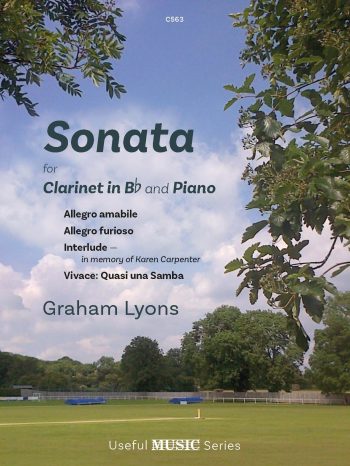
SONATA for Clarinet and Piano

SONATA for Clarinet and Piano

 
(0 reviews)  
Printed Edition
Composer:Lyons, Graham
Instrumentation:cl. pft.
Publisher Ref:C563
The Sonata is contemporary, nevertheless, each piece makes musical 'sense' on first hearing. Although sometimes challenging, the piece is written with care to suit the character and technique of the instrument. The third movement is written 'in memory of Karen Carpenter'. This new and definitive edition was published in July 2025 and includes Lyons's own revisions to earlier editions.
Price: £9.95
Qty
Skill Level:8
Series Title:Useful Music
Publisher:Clifton Edition
Year of Issue:2024
ISMN:M570815630
ISBN:none specified
The Sonata is contemporary, nevertheless, each piece makes musical 'sense' on first hearing.
Although sometimes challenging, the piece is written with care to suit the character and technique of the instrument.
The third movement is written 'in memory of Karen Carpenter'.

The YouTube video of the Sonata, recorded by Francisco José Gil (clarinet) and Laura Gómez (piano) is an imaginative performance, which uses a slightly older edition of the Sonata, most noticable in the final movement. In the Clifton Edition, Graham Lyons has made some small cuts in these places: * Bar 107 * Bar 134 * Bar 160

PERFORMANCE NOTES

I Allegro amabile: The metronome marks are a guide only. Once you are familiar with the music, feel free to alter the tempo and modify the phrasing to suit your style, your reed, the room acoustic—and even your blood/alcohol level. Trust your judgement. There are no hidden subtleties; what you hear is what you get.

II Allegro furioso: This movement is spiky, relentless and threatening. Play with maximum intensity keeping the tension throughout. There are no points of repose—certainly not the pause in bar 60, which should be carefully judged to make the audience wonder what’s going to happen next.
The movement demands as much from the pianist as the clarinettist. If the rhythm falters, excitement with be lost. Practice slowly together until you both know how the parts fit by ear—not by counting. The dovetailing of the parts from bars 93 to 114 needs special attention.
Even if you have mastered the movement technically, do not try to make it sound easy; the feeling of struggle should still be preserved. Keep the audience on the edge of their seats till the final note. Inject the incisiveness of an oboe or D trumpet into your tone.

III Andante: The mood here is in complete contrast to the preceeding movement. Play gently and reflectively, and a touch wistfully.
With her arranger and composer brother, Richard, Karen Carpenter was the singing half of a duo called The Carpenters. They were hugely popular in the 60s and 70s of the last century (unless you are reading this in a century later than the 21st!). She had one of the few really original voices in Pop music—warm and unaffected. She died in her early 30s following prolonged Anorexia Nervosa.
The Carpenters’ music has immedate and wide appeal. As a result, it has often been derided as bland and inconsequential. In fact, Richard Carpenter writes expertly using, with skill and taste, complex harmony, modulation, suspensions and pedal notes—and many other devices used in great music.

IV Vivace: This is in a Latin American, not Jazz, rhythm. The eighth notes (Brit. quavers) are played as written, not ‘swung’.
Don’t be tempted to take this movement too fast. Try to convey a sense of forward drive but without a hint of a scramble. The 10/8 section should sound as if you have played this meter all your life.

Note to amateur pianists For the ‘cut common’ sections, think of a two-beat main pulse subdivided into eight beats. Practice in strict time at half speed with no special emphasis on syncopated notes. Keep the tempo constant but relaxed, Brazilian - style. The clarinet player should feel that he or she is floating above a bouncing but secure rhythm.

The Sonata was composed in 1986.
  • Allegro amabile
  • Allegro furioso
  • Andante
  • Vivace

Delivery Details

We endeavour to dispatch all orders which are in stock on the day the order has been placed. If you need delivery by a certain time please state this clearly on your order and we will do our best to oblige.

For Royal Mail Special Delivery, Airmail (Signed For) and Courier shipments, a signature may be required upon delivery to your address. You are responsible for your order once the package arrives at the supplied delivery address. We cannot be held responsible if the package(s) goes missing once delivered. If any goods are received faulty or damaged on receipt, you must notify us within 7 days of receiving them (via email or telephone) quoting your order reference. We cannot be held responsible for goods that do not arrive with the customer due to errors made by the customer when entering their address details. Please ensure that you check all your details before confirming your order. For more information on deliveries, please click here.

Reviews

There have been no reviews yet.

Unrivalled Selection of Music

We offer a truly comprehensive selection of wind music online, with well over 100,000 titles listed, most of which are in stock and ready for immediate despatch.

We also stock a large range of theory and aural resources and specialist books.

First Class Service

We are absolutely committed to providing a first class service to musicians worldwide.

If you’re looking for a piece of music that isn’t listed on our website, we will do whatever we can to find it for you, no matter how long it takes.

VAT No: 172 1180 92 GB
EORI No: GB172118092000

Knowledgeable, Friendly, Helpful

We are a friendly, helpful team of people with lots of specialist knowledge.

For advice and information, contact us on +44(0)1439 788324 Monday to Friday (excluding Bank Holidays) between 9am and 4.30pm (GMT).